
Bird species profile
Band-tailed Earthcreeper
Ochetorhynchus phoenicurus
- Order
- Passeriformes
- Family
- Furnariidae
A closer look
Illustrated identification
 View larger
About the species
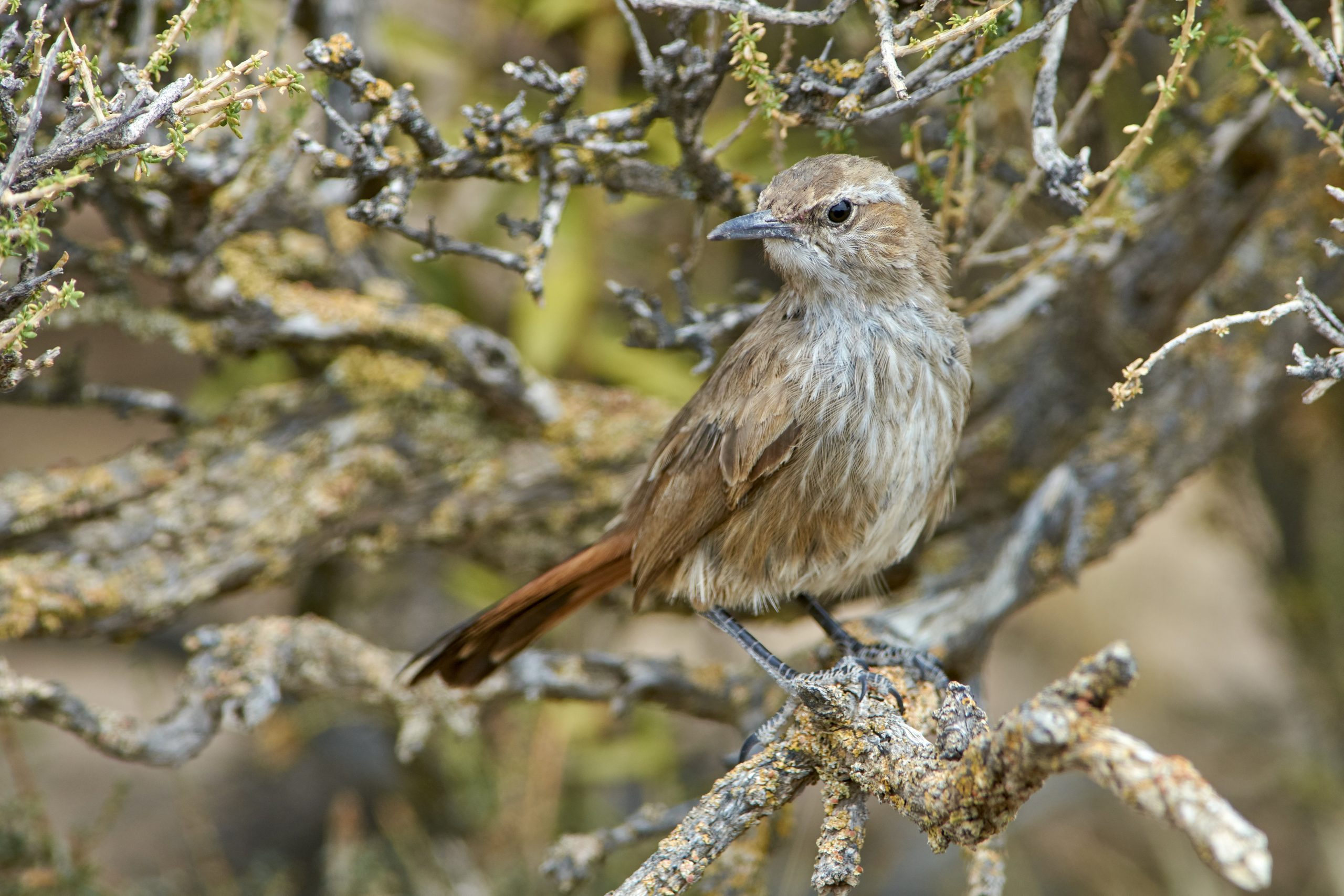
The Band-tailed Earthcreeper is a range-restricted, inconspicuous Patagonian specialty of arid steppe and shrubland. This medium-sized furnariid spends much of its time on or close to the ground, where its muted grey-brown plumage blends remarkably well with bare soil, stones and low vegetation.
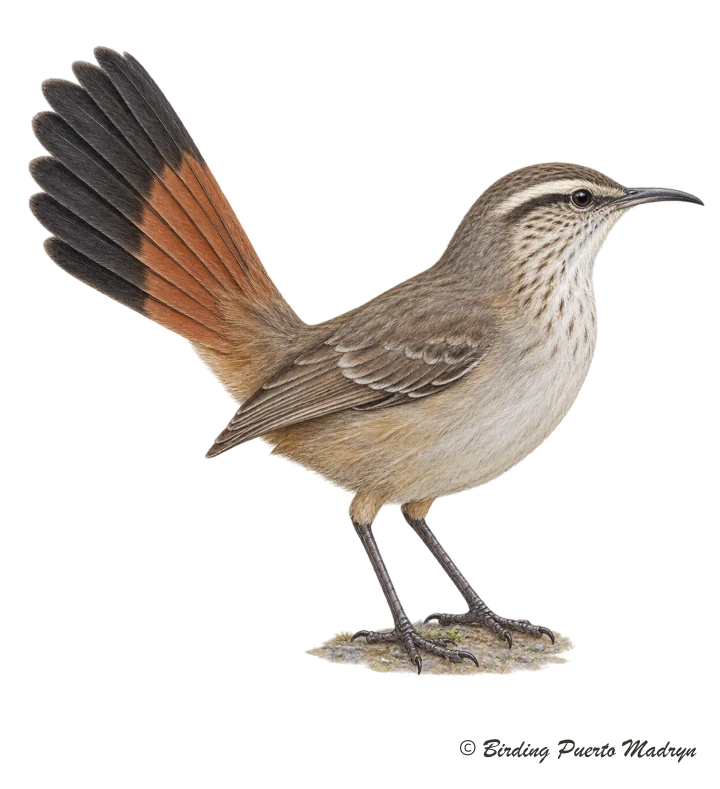
Look for a pale eyebrow, lightly streaked underparts, a long, slender and nearly straight bill, and the distinctive tail pattern: rufous at the base with a broad dark terminal band. The tail pattern can be difficult to appreciate until the bird moves quickly between shrubs or makes a short, low flight.
Behavior and voice
Usually encountered singly or in pairs, it walks and runs between bushes while searching the ground for arthropods. Its fast, dry trill can be surprisingly easy to overlook: at a distance it may blend into the soundscape like a subtle cricket or another insect. At other times it gives sharper, more conspicuous notes.
Habitat and distribution
It inhabits sparsely vegetated plains, plateaus and slopes in the Patagonian steppe and adjacent dry shrublands. Most of its range lies in Argentina, with a much more limited distribution in the eastern Magellanic steppe of far southern Chile. Long treated as an Argentine endemic, it was unknown in Chile before the 1990s; breeding there was confirmed in 1996.
Nesting
Unlike many other earthcreepers, it does not normally nest in a burrow. It builds a bulky, ball-shaped nest of thorny twigs with a side entrance, usually in a low bush or cactus, and lines the inner chamber with softer material such as wool, hair, feathers or plant matter.
Conservation
The Band-tailed Earthcreeper is currently classified as Least Concern globally. It is best described for birders as a localized Patagonian specialty rather than as a threatened species.
Foraging
It feeds mainly on arthropods, probing and gleaning on bare ground, among stones, and around grass clumps and low shrubs. Its habit of running through openings and disappearing beneath vegetation is one reason it can be difficult to follow even after it has been found.
Source
Illustrations and design © Birding Puerto Madryn / Tinamou Travel. All rights reserved.